By Rikki Zagelbaum, JNS
“College is difficult, but the thing that should be difficult in college isn’t whether or not you belong,” Eric Dinowitz, chair of the council’s Jewish Caucus, told JNS.
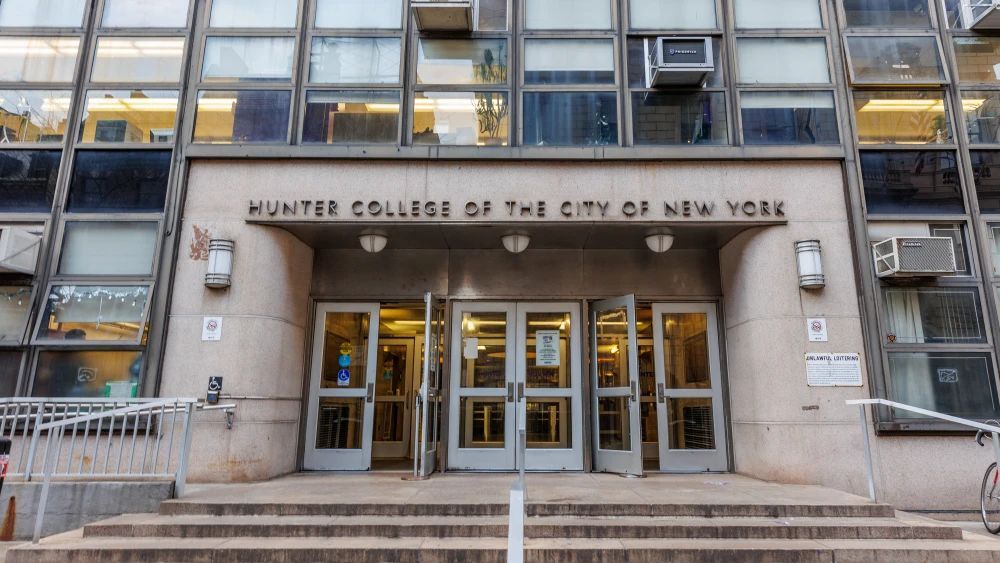
Three members of the New York City Council are calling on the City University of New York, a public system, to open a Title VI investigation into Hunter College canceling a cultural arts night because some participants objected to Hillel being included.
“If any student organization was excluded because of its members’ actual or perceived shared ancestry or national origin, that could violate the civil rights protections enshrined in Title VI,” Eric Dinowitz, Virginia Maloney and Lynn Schulman wrote to Félix Matos Rodríguez, chancellor of CUNY, on Nov. 20.
They asked that the CUNY system-wide office “initiate and oversee a Title VI investigation into the cancellation of this event and ensure accountability for any discriminatory conduct.”
The lawmakers cited previous incidents of Jew-hatred at Hunter, including protesters chanting “Jews on campus pick a side,” antisemitic graffiti and allegations that the college denied permission to display a Chanukah menorah.
“Excluding a student organization because of its members’ actual or perceived shared ancestry or national origin would betray the inclusive communities we are working to build,” they wrote. “That is why a full investigation is warranted, and that is why clear, enforceable rules must be implemented.”
Dinowitz told JNS on Monday that Hunter’s poor handling of previous Jew-hatred complaints raises questions about whether the college can adequately investigate the latest incident.
“First of all, there was the Office of Civil Rights complaint that sort of verified Hunter dropped the ball on investigating their own claims,” he said. “That alone should tell you what you need to know.”
“We’ve also heard directly from students that complaints often go nowhere,” he told JNS. “We need to make sure that all of our students have the right to express themselves, to engage in college life, and for college to be a welcoming environment.”
“Hunter has demonstrated that they have difficulties doing that,” he said.
Dinowitz chairs the City Council’s Jewish Caucus, where Schulman is vice chair, and Dinowitz is co-chair of the council’s bipartisan task force on Jew-hatred. Both are Jewish.
Maloney, who is not Jewish, told JNS in October that she “grew up in a proud Zionist household” and that combating Jew-hatred is one of her priorities on the council.
In June 2024, the U.S. Department of Education reached an agreement with CUNY to resolve nine complaints of discrimination based on shared ancestry, including at Hunter.
The federal investigation found that Hunter failed to adequately probe complaints about the disruption of two online classes in 2021, during which faculty members and students called for decolonizing “Palestine.” The United States doesn’t recognize an independent Palestinian state.
The agreement required Hunter to conduct a supplemental investigation.
Maloney told JNS that she has “confidence in Hunter’s administration, but given the nature of these allegations, I believe an independent investigation is warranted.”
“CUNY Central oversees Title VI compliance across its campuses, and we have an opportunity here to ensure that antisemitic discrimination is addressed consistently across the entire university system,” she said.
Dinowitz and Maloney have spoken with Hunter faculty members about the campus environment, they told JNS.
“Even before this event, students would share with me how ostracized they felt in and out of the classroom, and that’s a problem with the culture and environment,” Dinowitz said. “Even before the Office for Civil Rights investigation, for years and years there have been numerous complaints and investigations into Hunter.”
“Now, college is difficult, but the thing that should be difficult in college isn’t whether or not you belong,” he told JNS.
Hunter’s cultural arts night, which was scheduled for Nov. 16, was set to include several student organizations, including Hunter Hillel.
'The event doesn't align with our values'
Sumaiya Ahmed and Ahmad Waraich, president and vice president, respectively, of the Hunter Undergraduate Student Government, said on Nov. 14 that the event was canceled.
“We hear what the student body has said, and we have made the decision to cancel the event as it doesn’t align with our values or the values of the students we represent as the Hunter community,” they said.
The student government later cited “safety concerns” and the withdrawal of “several participating organizations” as reasons for the cancellation. Comments on the post were disabled “due to safety concerns and hateful rhetoric,” it said.
Nancy Cantor, president of Hunter College, said on Nov. 18 that the event was not canceled to exclude Hillel but acknowledged reports that some organizations withdrew because the Jewish group was slated to participate.
The college is investigating those circumstances under its discrimination and harassment policies, Cantor said. She also said that there would be new constructive dialogue training requirements for student government members and leaders of recognized student organizations.
In their letter, the City Council members noted CUNY’s efforts to address Jew-hatred, including mandatory Title VI training for full-time employees, and the City Council’s increased funding for the university system’s Constructive Dialogue Initiative.
“Protecting students requires more than programs that bring people together. It requires accountability,” they wrote.
Maloney told JNS that CUNY “has made meaningful progress, particularly through mandatory Title VI training for staff.”
“At the City Council, we’ve made combating antisemitism a priority through investments in Holocaust education, a legislative package addressing antisemitism and the work of our Task Force to Combat Antisemitism,” she said. “This includes my own legislation, now law, which requires NYPD to consult with houses of worship to strengthen emergency preparedness at religious institutions.”
“Across all levels of government and our educational institutions, we need to be as committed to enforcing these protections as we are to establishing them,” Maloney told JNS. “Jewish students deserve to see that commitment reflected in their experience on campus.”
The lawmaker is “optimistic” that Hunter will comply with the letters’ demands.
“CUNY is one of our city’s greatest public institutions, and I appreciate the work its leadership has done to address antisemitism,” Maloney told JNS. “I look forward to working constructively with them to ensure these allegations receive the scrutiny they deserve.”
Dinowitz told JNS that CUNY’s efforts to address Jew-hatred remain insufficient.
“There’s a lot missing,” he said.
Education isn’t only about sitting in a classroom, according to the lawmaker.
“It means creating the environments by which students are learning the skills of talking to one another,” Dinowitz told JNS. “It means creating environments where students can be who they are, and it also means ensuring that there are clear guidelines for what is and isn’t acceptable, and that there are consequences when students violate other students’ rights.”
Universities that fail to investigate discrimination complaints risk attracting federal scrutiny, according to Dinowitz.
“We see colleges across the country declining to investigate, and then there are civil rights investigations opened up against them,” he said.
He noted that the federal civil rights probe of Hunter began not during the Trump administration but when President Joe Biden oversaw the Education Department.
“We want colleges and universities to have their autonomy,” he told JNS. “We want them to function independently, and that means living up to the promise that every student is welcome and has a home at each and every one of our colleges.”
Dinowitz did not specify what consequences student government officials should face if an investigation determines that Hillel was excluded because it is a Jewish group.
“This is all part and parcel of an investigation,” he said.
“It’s not just the individual students who may have acted,” he told JNS. “It’s the type of environment and culture that Hunter is clearly allowing to flourish.”
“That’s why CUNY Central needs to take a stronger stand on this, make the investments where appropriate and conduct the investigation and deliver consequences where appropriate,” he said.