By Aaron Bandler, JNS
A GOP consultant told JNS that “if the Democrats take the U.S. Senate, and that is far from certain, I would expect more criticism of Israel, especially if Netanyahu is still in charge.”
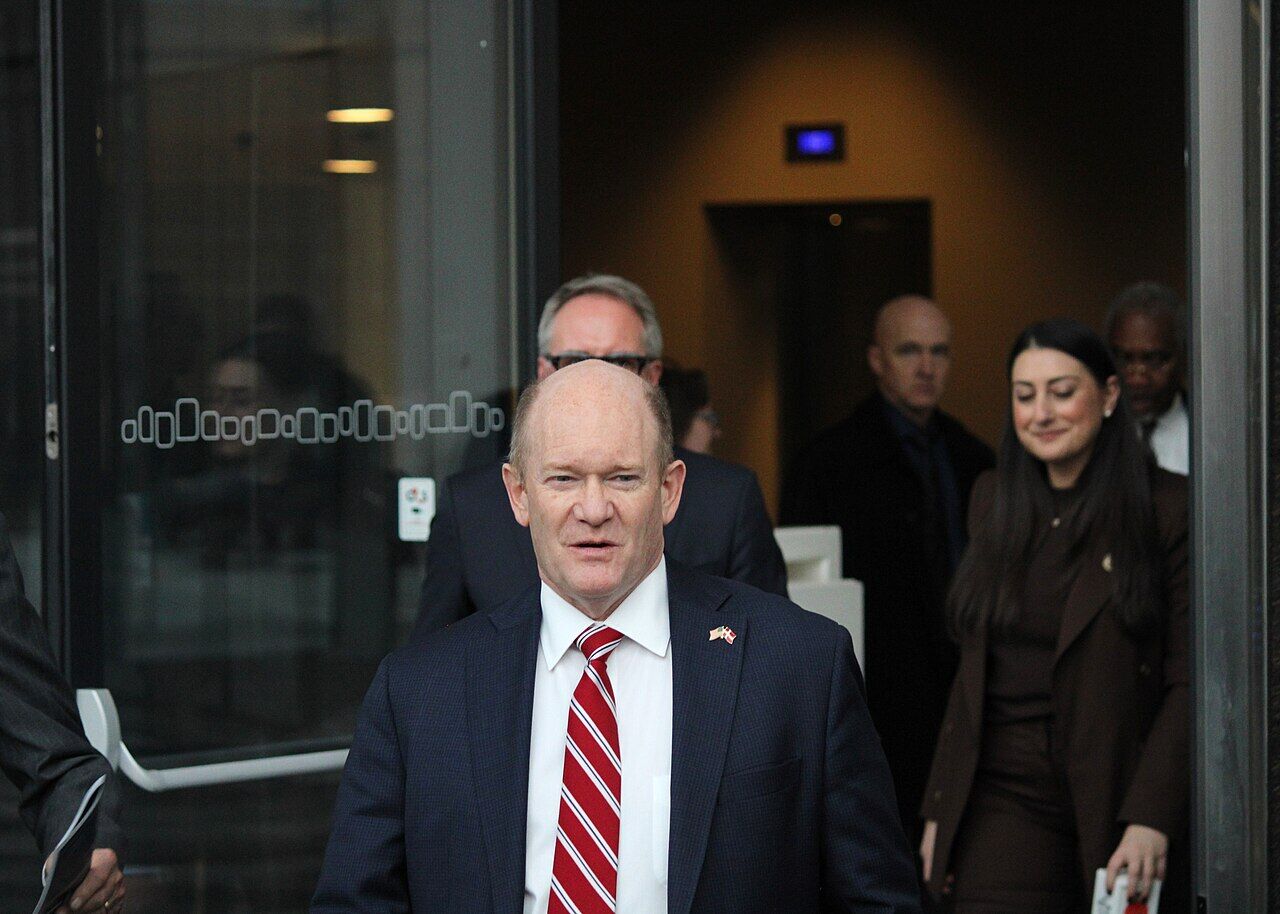
If Democrats take the Senate in November, Sen. Chris Coons (D-Del.), a close ally of former President Joe Biden, is expected to become chair of the powerful Senate Foreign Relations Committee, as the second-in-line after retiring Sen. Jeanne Shaheen (D-N.H.), the panel’s current ranking member.
If that happens, Joel Rubin, a former deputy assistant U.S. secretary of state for House affairs in the Obama administration, expects that there will be an “uptick in oversight when it comes to the Israel portfolio” compared to the current committee, under chair Sen. James Risch (R-Idaho).
Risch is a “longstanding hawk, who’s very supportive of Trump on Iran” and has “been a very good voice on Ukraine and Russia,” according to Rubin, who was the State Department’s chief liaison to the House of Representatives in 2014 and 2015.
The Idaho Republican has been more of a “quiet supporter” of Israel and tends to defer to Marco Rubio, U.S. secretary of state, and to the State Department, according to Rubin, who has run for public office as a Democrat and who has worked for J Street and as Jewish outreach director to the presidential campaign of Sen. Bernie Sanders (I-Vt.).
More recently, he runs a national security strategic advisory firm, and he has warned about rising Jew-hatred on the Left.
Rubin sees Coons as an “interesting guy,” who “really carved out a niche as a leader on Africa and international development to a certain extent as well.”
The Delaware Democrat has been “consistently, staunchly pro-Israel” and was a “wingman” to Biden, but “because of the pressures inside the party and the concerns about the Netanyahu policy, he’s talked about more oversight, more questions about the structure of the aid program,” Rubin told JNS. “The questions about how money is spent, questions about the peace process and whatnot.”
Matt Klink, a Republican political consultant, told JNS that “the Democratic Party has moved away from Israel, as it caters to more progressive viewpoints among its constituents across the nation.”
More than three dozen Democrats backed Sanders’ bid in April to block arms sales to Israel, “and the two measures failed 40 to 59 and 36 to 63,” Klink told JNS. “Shaheen supported both measures. She has also blocked a $2.8 billion arms sale since July.”
“A ranking member’s hold means State generally won’t formally transmit the sale, though nothing binds the administration,” he said.
“If the Democrats take the U.S. Senate, and that is far from certain, I would expect more criticism of Israel, especially if Netanyahu is still in charge,” Klink told JNS. “President Trump would be a backstop for Israel, as would most Republicans.”
Generally, chairmanship and ranking membership of congressional committees are based on seniority, which would suggest that Coons would be next in line if Democrats take the Senate.
Scott Huffmon, a political science professor at Winthrop University, in Rock Hill, S.C., and director of its Center for Public Opinion and Policy Research, told JNS that Democrats “don’t automatically lean as heavily on seniority, but seniority is likely to be the mechanism and tends to be the rule.”
Klink noted that Sen. Jacky Rosen (D-Nev.), whom he called “a pro-Israel voice in a room that is drifting away from Israel,” is a ranking member of the panel’s Subcommittee on Near East, South Asia, Central Asia and Counterterrorism.
The primary function of the Senate Foreign Relations Committee, according to Rubin, the former Foggy Bottom official, is to oversee the State Department, including confirming the U.S. secretary of state, assistant secretaries and ambassadorships and overseeing the department’s functions.
The committee also considers legislation authorizing the department and war authorizations. It is one of two committees, along with the Senate Banking Committee, to get a “bite at the apple” on sanctions legislation, according to Rubin.
The committee also has an oversight role in foreign military financing and foreign military sales.
“Any provision of aid to Israel for purchase of American weapons systems through that program will get conducted by the State Department,” Rubin told JNS. “Then they will notify Congress that they are going to expend those funds.”
“That then goes to the Senate Foreign Relations and the House Foreign Affairs Committees, and they review those requests, and they have a back-and-forth, a dialogue,” he said. “They either let it pass through or they hold on to it due to questions.”
'Going to get really contentious'
The current U.S.-Israel memorandum of understanding is slated to expire in 2028, when there will be a U.S. presidential election and potentially a new Israeli government, which is “going to be crazy,” Rubin said.
“If Democrats are going to—from a legislative process perspective—support some kind of MOU, the trade-off might very well be about oversight and conditions and the kinds of usage that they will build into any agreement,” he told JNS. “That’s where it’s going to get really contentious.”
Rubin predicted that if Dr. Abdul El-Sayed, former Detroit health director and the Democratic nominee for Senate in Michigan, wins and becomes part of a Democratic-majority Senate, “he could stop every bill that supports Israel.”
“Every dollar that goes out, he could go to the floor and demand a vote and negotiate and be incredibly impactful, even if he’s not on the committee,” he said. “It will put extraordinary pressure on people like Coons and Schumer and the leadership to try to figure out how to get him to not hold and to not block and to compromise.”
The Republican Jewish Coalition has called El-Sayed “the most antisemitic U.S. Senate candidate in America.”
Huffmon, the Winthrop professor, told JNS that Coons, the Delaware Democrat, “has been a strong supporter of Israel in the past and talked of the right to defend itself.”
But the senator in line to chair the committee should Democrats take the Senate has become “increasingly critical” of Israeli Prime Minister Benjamin Netanyahu, Huffmon said.
Coons told Politico earlier this month that “we need to have a thorough reexamination” of the U.S.-Israel relationship and that he is open to sanctioning even Netanyahu if the Israeli government “continues on its current path.”
Huffmon told JNS that Coons “has been against unconditional restrictions on arms sales to Israel” but has supported the possibility of certain conditional restrictions.
In 2024, Coons told Wolf Blitzer of CNN that he would be in favor of restricting Israeli military aid if the Jewish state went “ahead with a full-scale ground campaign into Rafah without taking into account their obligation under international law to protect civilians and to facilitate the distribution of aid.”
Coons has also “been critical of restrictions on humanitarian aid in Gaza, and he has voted to end the war with Iran,” according to Huffmon.
“I would speculate that those votes are more about proper constitutional powers and internal politics and less about voting for or against Israel’s interests,” the professor told JNS.
“However, I cannot express how much that is a wild guess,” he cautioned. “I have exactly zero insight on it.”